$0 Fee, Until You WIn



No Fees Unless We Win Your Case
Ready to Take the Next Step? Get Your Free Personal Injury Consultation Today!

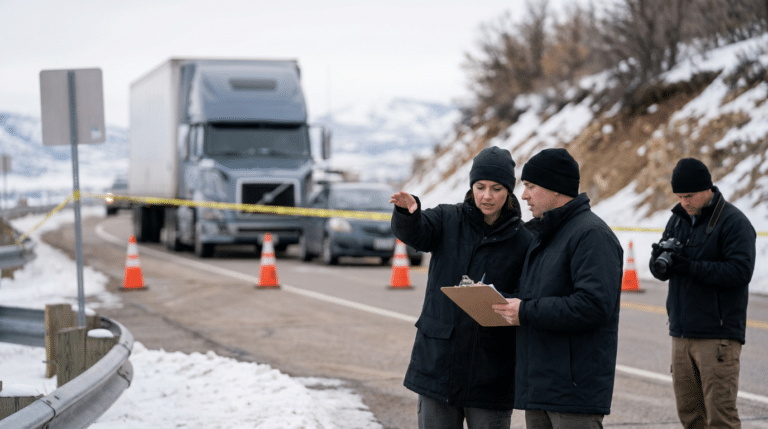
A car accident in Utah throws your life into immediate chaos. From the shock of impact to navigating insurance claims and potential injuries, knowing your legal rights and responsibilities is critical for protecting yourself and your future.
Delay or missteps can jeopardize your health, your compensation, and your peace of mind. This checklist provides clear guidance on the essential legal steps to take immediately after an accident and during the complex claims process.
After a car accident in Utah, prioritize safety by moving to a secure location and checking for injuries. Immediately call 911 to report the incident, which creates an official record. Exchange insurance and contact information with all parties involved, and thoroughly document the scene with photos and videos. Seek prompt medical attention, even for minor symptoms, and consult with a qualified Utah personal injury attorney before speaking extensively with insurance companies.
Table of Contents:
The moments immediately following a car accident are often confusing and stressful, but your actions can significantly impact any future legal claim. Remaining calm and following a structured approach protects your safety and preserves critical evidence.
Your first concern after an accident must be the safety of everyone involved. Move your vehicle to the side of the road if possible and safe to do so; otherwise, activate hazard lights to alert oncoming traffic, especially on busy Utah highways like I-15 or I-80.
Check yourself and any passengers for injuries, even minor ones. Adrenaline can mask pain, so observe carefully before assuming you are unharmed.
Disclaimer: This content is for informational purposes only. Consult a qualified professional for specific guidance.
Always call 911 after a car accident in Utah, regardless of how minor it seems. This ensures emergency services can respond, creates an official police report, and documents the incident.
A police report provides an unbiased account of the accident, including details like road conditions, vehicle positions, and initial statements, which is invaluable for your claim.
Pro Tip: Even if law enforcement determines the damage is too minor for a written report, ask them to note your presence and their assessment. This still provides official validation an accident occurred.
After ensuring safety and contacting emergency services, exchange necessary information with all other drivers involved. Collect their name, contact number, insurance company and policy number, driver’s license number, and vehicle license plate number.
Limit your discussion to exchanging information and brief factual statements about how the accident occurred. Avoid admitting fault or speculating about the causes, as these statements can be used against you later.
The accident scene contains critical evidence that quickly disappears, so document everything while you are still there. Use your phone to take numerous photos and videos from multiple angles.
Capture vehicle damage, road conditions, traffic signs, skid marks, debris, and the surrounding environment, including landmarks near Park City or specific exits on the Wasatch Front. Get wide shots showing the location and close-ups of specific details. Cat H, a client of Eaton Injury Law, consistently praised Tyler Eaton’s quick responses, which is directly supported by proactive evidence collection at the scene.

Leaving the accident site doesn’t mean your responsibilities end; important actions immediately follow to protect your health and legal rights. These steps form the foundation of a strong personal injury claim.
Seek medical attention immediately after an accident, even if you feel fine. Many serious injuries, particularly those affecting the neck, back, or head, have delayed symptoms.
A prompt medical evaluation establishes a clear link between the accident and your injuries, creating critical documentation for your claim. Delayed treatment can lead insurance companies to argue your injuries weren’t caused by the accident.
Notify your own insurance company of the accident promptly, as required by most policies. Provide only the basic facts: where, when, and who was involved.
Do not give a recorded statement or discuss fault, specific injuries, or the extent of vehicle damage until you have consulted with an attorney. George Gradinaru, a client, praised Tyler Eaton as “one of the most professional, quick and on the spot attorney[s] I worked with,” emphasizing the value of expert legal guidance during this critical communication.
Pro Tip: Even if your insurance company seems to be on your side, their primary goal is to minimize payouts. Stick to the facts and avoid speculation.
Utah operates under a “no-fault” insurance system, which means your own Personal Injury Protection (PIP) insurance typically covers your initial medical expenses and lost wages, regardless of who caused the accident. Utah law mandates minimum PIP coverage of $3,000 for medical expenses.
You can pursue a claim against the at-fault driver only after your medical expenses exceed a certain threshold (the $3,000 PIP limit) or if you sustain specific types of serious injuries. Understanding this system is vital for navigating your claim effectively.
Speak with a personal injury attorney at Eaton Injury Law today for a free case review.
Navigating the legal aftermath of a car accident in Utah involves understanding specific laws and procedures. Your approach to these legal considerations can significantly impact the outcome of your case.
Contact a Utah car accident attorney as soon as possible after an accident. An experienced attorney protects your rights, handles communication with insurance companies, and builds a strong case for compensation.
This is especially true if you’ve sustained injuries, disputes arise over fault, or the insurance company offers a low settlement. Clients consistently praise Tyler Eaton for his helpfulness and expertise in navigating these complex situations, as noted by Jack Harris and Zach Stout.
Eaton Injury Law offers free consultations to discuss your situation and evaluate your options without obligation.
Utah follows a modified comparative negligence rule, meaning you can recover damages even if you are partially at fault, as long as your fault is not greater than the combined fault of all other drivers.
For example, if you are found 20% at fault and the other driver is 80% at fault, you can still recover 80% of your damages. Proving the other party’s negligence is critical for maximizing your compensation.
In Utah, you generally have four years from the date of the accident to file a personal injury lawsuit. This is known as the statute of limitations.
Missing this deadline typically means you lose your right to pursue compensation, regardless of the severity of your injuries or the strength of your case. Certain circumstances, like claims involving minors, can alter this timeline.
Motorcycle accident claims also fall under this statute, requiring prompt legal action.
The other driver’s insurance company is not on your side; their goal is to minimize their payout. They may contact you quickly, seeking recorded statements or offering a swift, low settlement.
Never provide a recorded statement or accept any settlement offer without first consulting with your attorney. Your legal ally handles all communication, ensuring your rights are protected and you don’t inadvertently jeopardize your claim.
We work on a “No Win, No Fee” basis, meaning you pay absolutely no legal fees unless we successfully win or settle your case. This removes financial barriers and demonstrates our confidence in delivering results. Your recovery is our priority.
A successful car accident claim hinges on thorough documentation and preserved evidence. Beyond the initial scene documentation, ongoing efforts to collect and organize information will strengthen your case.
All medical records and bills related to your accident injuries are vital evidence. These documents prove the extent of your injuries, the treatments received, and the costs incurred, forming a cornerstone of your compensation claim.
Keep organized copies of everything, from initial emergency room visits to physical therapy notes and prescription receipts. This complete collection allows us to effectively calculate your past and future medical expenses.
Keeping a detailed journal of your experience after the accident is invaluable. Document your daily pain levels, physical limitations, emotional distress, and how your injuries impact your daily life.
Include details about missed work, appointments, and any conversations you have regarding the accident. This personal account often provides critical, humanizing details that strengthen your claim beyond clinical medical records.
Pro Tip: Even seemingly small details, like difficulty sleeping or struggling with household chores, contribute to understanding the full impact of your injuries.
Car accidents generate many questions, especially concerning the unique aspects of Utah law. Addressing these common inquiries can clarify the path forward.
Utah’s no-fault law requires your own Personal Injury Protection (PIP) insurance to cover the first $3,000 of your medical expenses, regardless of fault. This is the “threshold.”
You can only step outside the no-fault system and pursue a claim against the at-fault driver for further damages (like pain and suffering) once your medical bills exceed this $3,000 threshold, or if you sustained specific types of severe injuries defined by statute.
Utah’s modified comparative negligence rule directly affects your compensation in an accident. If you are found to be 50% or less at fault for the accident, you can still recover damages reduced by your percentage of fault.
However, if your fault is determined to be 51% or greater, you cannot recover any damages from the other party. Establishing clear liability is therefore critical, which underscores the importance of prompt investigation and legal counsel.
The aftermath of a car accident in Utah is a challenging period, demanding careful attention to both immediate safety and long-term legal strategy. From securing the scene to understanding complex insurance laws, every step you take influences your ability to recover deserved compensation.
Do not face the overwhelming process alone, especially when dealing with injuries and aggressive insurance adjusters. Our “No Win, No Fee” policy ensures expert legal help is accessible to everyone, regardless of their current financial situation.
Facing the aftermath of a car accident requires more than just medical care; it demands expert legal guidance to ensure justice and fair compensation. We understand the physical, emotional, and financial toll an accident takes on your life.
We’re here to help, offering complete support and personalized attention to clients across Utah. Recover what’s yours and let us be your partner in these tough times.
Contact Eaton Injury Law today for a free case review. Let us pursue the compensation you deserve so you can focus on your recovery.




Definitely recommend! Tyler has been so patient and always so easy to get a hold of when I have questions. I’m so glad I chose strong law. You will be too!

Great to work with. Communicates very well and professional. Would definitely recommend and use again if there was a need.

Strong Law is a trustworthy law firm that helped me with my auto accident case! They have done a great job, and answered all my questions fast and accurately! I would highly recommend this law firm to friends, family or other professionals! Thanks so much for your service!

Tyler was there every step of the way, more concerned about my needs and wants then even the Dr. thank you so much for your help in my recovery not only financial but my health and mental state

Mr Eaton was truly exceptional to work with, illuminating every step of the journey from start to finish with clarity and simplicity, empowering both myself and my daughter to secure rightful compensation for the lifelong injury I sustained in the accident, as well as going above and beyond to support my daughter's compensation. I had resigned myself to living with daily physical pain, but Mr Eaton helped us discover the ideal medical professionals to alleviate my suffering without resorting to medication, enabling me to thrive as a mother. I recommend him and trust him to your family and loved ones

Excellent Attorney!! Professional, kind,Tyler excelled way beyond my expectations in all ways,just Wow!He stayed on top of my case diligently & had to work with a very difficult defendant.I was able to get a fair settlement for my medical expenses,it took some time,but he never gave up.I will be forever grateful for his help & will highly recommend him to everyone looking for a injury Attorney .This Young Man is a "Badass" Attorney ...and now I also consider him a Friend .Thank You from the bottom of my Heart ❤️ Tyler Eaton .May God bless You always....I will Never forget how hard you fought for me & justice to be served

1000% recommend Eaton Injury law!! I was hesitant of pursuing anything, but Eaton Injury Law made the entire process so easy and less stressful for me. Tyler was a pleasure to work with, very patient and professional.

100% recommend Eaton Injury law! Tyler was amazing and really dove in to our case. He responded quickly and was entirely professional. Amazing service!

I’ve had the pleasure of working with Attorney Tyler Eaton on several cases, and I couldn’t be more impressed. Having worked with many attorneys, I can confidently say Tyler is one of the best. He is highly professional, extremely responsive, and always reliable. Tyler handled each case with great skill and attention to detail, ensuring the best possible outcomes. His dedication and expertise truly set him apart. I highly recommend him!

I worked with a lot of attorneys for the last 10 years and I can say it from the bottom of my heart that Tyler one of the most professional, quick and on the spot attorney I worked with!

Tyler is amazing, he always responds quickly to any questions I’ve had and he got me the best possible outcome on my case!

Tyler Eaton is excellent to work with—knowledgeable, thorough, and dedicated. Highly recommend!

Working with Eaton Law Group is always smooth, time efficient and productive. I certainly recommend their service for the best experience .

I recently had the pleasure of being represented by Mr. Eaton in a personal injury case, and I cannot recommend him highly enough. From the outset, Mr. Eaton was not just a lawyer but a genuine advocate for my well-being. His responsiveness and communication were outstanding; he was always available to answer my questions and kept me informed every step of the way. Working with Mr. Eaton was incredibly easy and stress-free, a drastic difference from other attorneys I have worked with in the past. Most importantly, Mr. Eaton's expertise and diligence resulted in a reasonable settlement that fairly compensated me for my injuries. It was clear from the beginning that he was fully committed to getting me the best possible outcome, and he delivered on that promise. For anyone in need of a personal injury attorney who goes above and beyond, Mr. Eaton is your go-to. His professionalism, kindness, and exceptional legal acumen set him apart. I am deeply grateful for his support and the successful resolution of my case.

Eaton law group was professional and quick to answer all the legal questions I had concerning my case. I felt a personal connection and care that is rare in the world of personal injury law

Tyler Eaton is a very knowledgeable and kind personal injury attorney. Very good at what he does! Definitely knows what he is doing

My experience with Eaton Law Group was excellent. Tyler Eaton is an exceptional personal injury attorney. He is ethical, knowledgeable, and very well organized. Along with that, he kept me well informed and answered questions in a timely manner. I would use their expertise again and I recommend it to others.

As a client of Tyler Eaton, I can say he’s the best in the business. Mr. Eaton, responds in a timely manner, answers all of my questions in depth and detailed. Had all of my legal documents typed up and sent to me very fast. After my documents were sent, he called me and went over the paperwork with me.

I was in need of a good law firm for my assault case. Attorney Tyler Eaton took my case and supported me . I have to underline the Professionalism, Honesty, Reliability Eaton Law Group showed towards me during the whole time “ Thank you Mr Tyler Eaton “


